5BX: The 11-Minute Air Force Fitness Plan
The 11-Minute Workout That Kept Cold War Pilots Combat-Ready (And Why It Still Works Today)
What if I told you that one of the most effective fitness programs ever designed requires no equipment, no gym membership, and just 11 minutes of your day?
No gimmicks. No expensive gear. Just five exercises that were literally engineered to keep fighter pilots alive.
This is the story of the 5BX workout—a Cold War-era fitness system that became a global phenomenon, influenced a king, and remains surprisingly relevant nearly seven decades later.
Born from Necessity at 30,000 Feet
Picture this: It's the late 1950s. The Royal Canadian Air Force has a problem. Their pilots stationed at remote Arctic bases—far from gyms, trainers, or even basic exercise equipment—are getting dangerously out of shape.
In an era of nuclear tension and constant readiness, an unfit pilot wasn't just a liability. He was a potential catastrophe.
Enter Dr. Bill Orban, an exercise physiologist tasked with solving an impossible equation: How do you keep military personnel in peak condition when they have no access to facilities, minimal time, and are stationed in some of the harshest environments on Earth?
His answer was elegantly simple. Strip fitness down to its absolute essentials. Create a program that anyone could do, anywhere, in the time it takes to brew a pot of coffee.
The 5BX Plan—Five Basic Exercises—was born.
What Exactly Is the 5BX Workout?
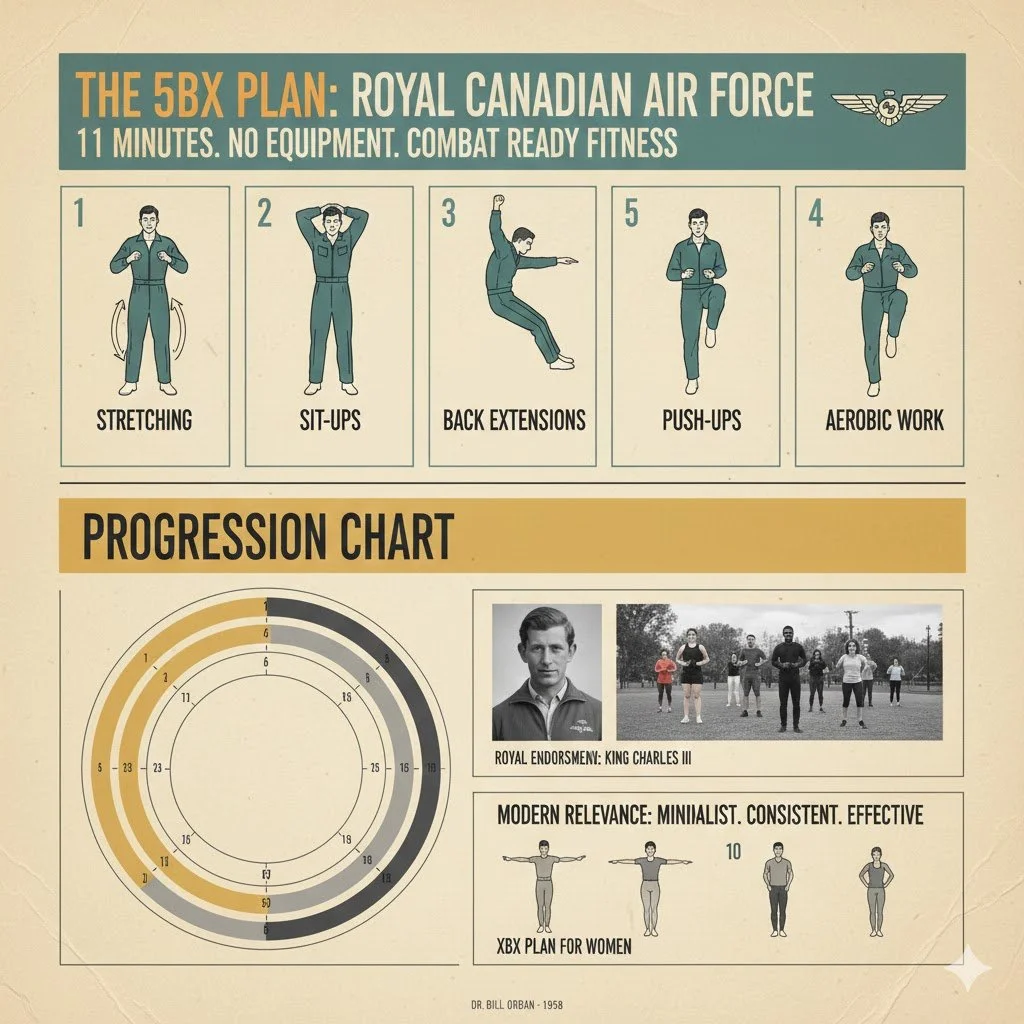
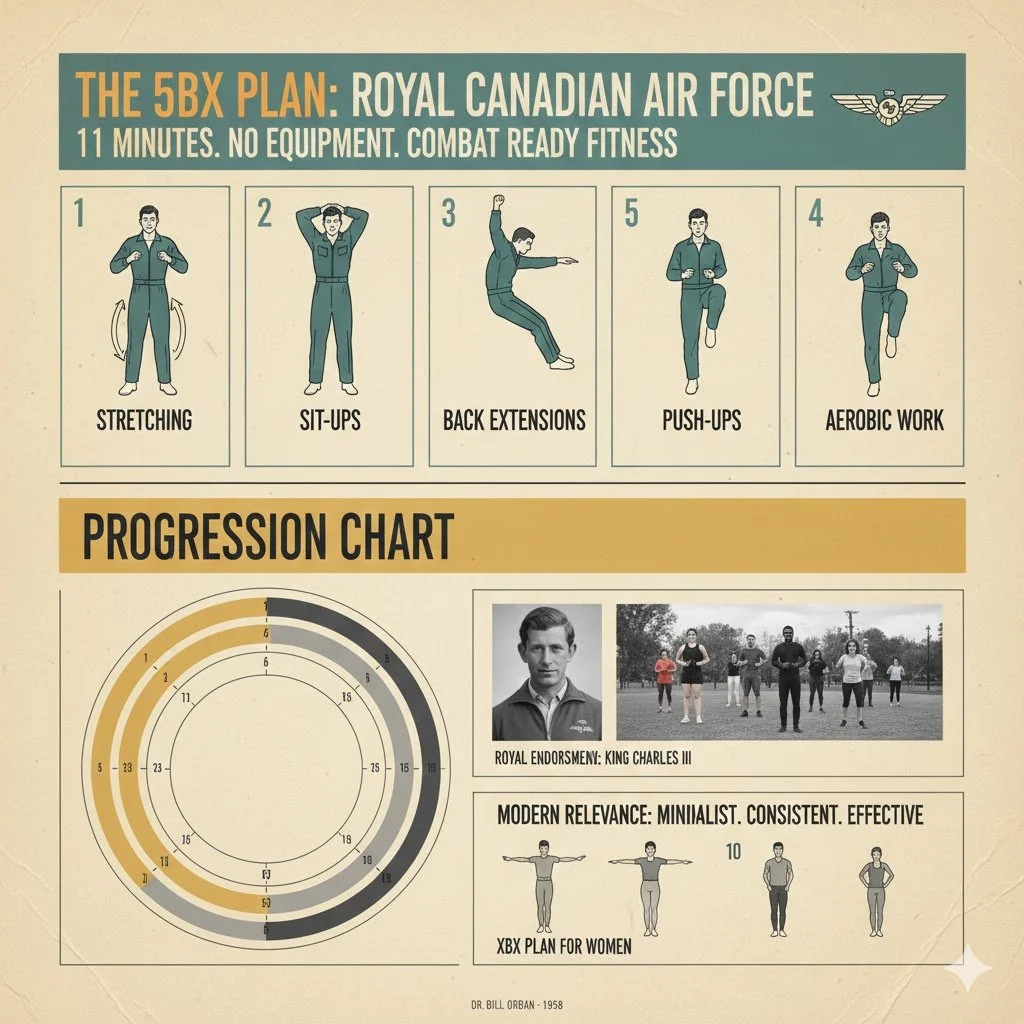
The program consists of five exercises performed in a specific sequence every single day. No exceptions. No complicated periodization. Just consistent, progressive effort.
Here's the lineup:
Exercise 1: Stretching
Think toe touches, side bends, and arm circles. This isn't passive stretching—it's dynamic movement designed to prepare your body for what's coming.
Exercise 2: Sit-Ups
Core strengthening through standard sit-ups or more challenging variations involving twisting and leg raises as you progress.
Exercise 3: Back Extensions
Movements like supermans or prone leg lifts that strengthen the posterior chain—the muscles along your spine that most desk-bound workers desperately neglect.
Exercise 4: Push-Ups
The classic chest-to-floor push-up, with modifications available for beginners and progressively harder variations for the advanced.
Exercise 5: Aerobic Work (6 minutes)
This is where the heart rate climbs. Running in place combined with dynamic movements like half knee bends, scissor jumps, or semi-spread eagle jumps. If you prefer, outdoor walking or running can be substituted.
Total time: 11 minutes. That's it.
The Genius of Progressive Overload
What makes 5BX remarkable isn't just its simplicity—it's the built-in progression system.
The original program included six charts of increasing difficulty. You don't just do the same workout forever. As your fitness improves, you advance through the charts by increasing repetitions, extending time, or tackling harder exercise variations.
The guiding principle? You should finish challenged but not destroyed. If you're gasping on the floor afterward, you've gone too hard. If you barely broke a sweat, it's time to level up.
This mirrors what modern exercise science calls the minimum effective dose—the smallest amount of training stimulus needed to produce adaptation. It's the same philosophy behind today's popular HIIT programs, except Dr. Orban figured it out with slide rules and military necessity rather than heart rate monitors and peer-reviewed journals.
A Royal Endorsement
The 5BX program exploded beyond military circles in the 1960s, selling millions of copies worldwide.
Among its devoted practitioners? King Charles III himself, who reportedly used the program for years. When royalty commits to an 11-minute daily routine, it says something about both the program's accessibility and its effectiveness.
Where 5BX Falls Short
Let's be honest: fitness science has evolved significantly since the Eisenhower administration.
The program has notable gaps:
- Limited lower-body focus. There are no squats, lunges, or dedicated leg exercises. The aerobic portion provides some leg work, but it's not comprehensive strength training.
- No pulling movements. Push-ups are excellent, but there's nothing targeting the back muscles through pulling actions like rows or pull-ups.
- Some variations feel dated. Exercise progressions that seemed cutting-edge in 1958 might feel basic compared to what we know about functional movement today.
For general health and fitness maintenance, 5BX delivers. For building significant muscle or addressing specific athletic goals, you'll likely need supplementation.
A Note for Women
Dr. Orban also developed a companion program called XBX—Ten Basic Exercises for women—featuring 10 exercises completed in 12 minutes. The structure and philosophy remain the same, adapted for different baseline fitness considerations common in that era.
Should You Try It?
Here's what I find compelling about 5BX in 2025:
We're drowning in fitness complexity. Apps tracking every metric. Programs requiring equipment investments. Routines demanding hour-long gym sessions. Influencers insisting their method is the only path to results.
Meanwhile, there's this 70-year-old program quietly making a case that fitness doesn't have to be complicated. That consistency beats intensity. That something done daily outperforms something done perfectly but rarely.
If you've struggled to maintain a fitness routine, 5BX offers a radical proposition: What if you stopped optimizing and started showing up?
Eleven minutes. Every day. No excuses accepted.
The original pamphlet included a physician consultation recommendation, and that advice holds true today—especially if you're returning to exercise after a long break or managing health conditions.
The Bigger Question
The 5BX workout challenges our modern assumptions about what effective exercise requires. We've convinced ourselves that results demand extensive time commitments, specialized equipment, and expert guidance.
But what if the Cold War Canadians were onto something? What if the best workout isn't the most sophisticated one—it's simply the one you'll actually do?
---
I'd love to hear from you: Have you tried minimalist fitness programs like 5BX? Do you think modern workout culture has become unnecessarily complicated? Drop your thoughts in the comments below.
If this post gave you something to think about, share it with someone who's been struggling to find time for fitness. Sometimes the old ways work best.