Leg Day After 40: Stronger Legs, Safer Joints
Leg Strength Exercises for Men Over 40: Build Power Without Wrecking Your Knees
Because training smarter beats training harder—especially now.
---
Let's be honest: your body at 42 isn't the same as it was at 22. And that's not a defeat—it's just reality.
Maybe you've noticed your knees protest a little louder after a heavy squat session. Perhaps that recovery time has stretched from one day to three. Or maybe you've simply realized that loading up a barbell and grinding through pain isn't the flex it used to be.
Here's the good news: you can absolutely build strong, powerful legs well into your 40s, 50s, and beyond. You just need to train differently.
The key? Joint-friendly exercises that prioritize movement quality, controlled tempo, and intelligent programming over ego-lifting. Let's break down exactly how to do it.
---
Why Leg Training Changes After 40
Before we dive into the exercises, let's understand what's actually happening in your body:
Joint wear accumulates. Decades of activity (or inactivity) affect cartilage, tendons, and ligaments. Heavy compression loads—like barbell back squats—can aggravate existing issues or create new ones.
Recovery slows down. Your hormonal profile shifts, and the inflammatory response to training takes longer to resolve. What once required 48 hours now might need 72 or more.
Stability becomes crucial. Muscle imbalances that you could compensate for in your 20s now lead to injury. Single-leg work and hip stability aren't optional anymore—they're essential.
But here's what doesn't change: Your muscles still respond to progressive overload. Your nervous system still adapts to new challenges. You can still get stronger, more mobile, and more functional.
You just need the right exercises.
---
The Essential Leg Exercises for Men Over 40
1. Walking Lunges (and Variations)
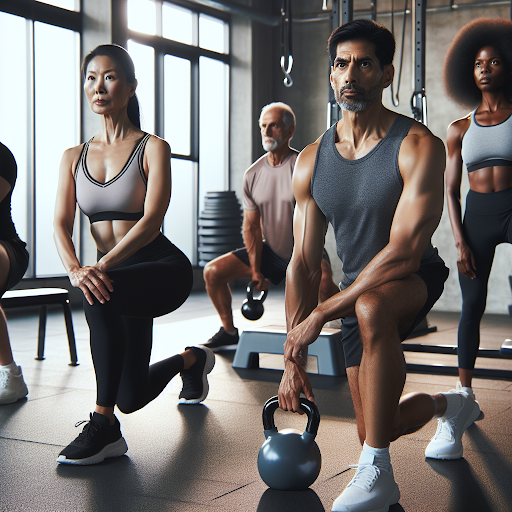
Walking lunges might be the single best lower-body exercise for men over 40. They build strength, improve balance, train deceleration (crucial for injury prevention), and develop hip stability—all while being far more joint-friendly than heavy squats.
How to do them:
- Step forward into a lunge position, creating 90-degree angles at both knees
- Keep your core engaged and torso upright—no forward lean
- Drive through your front foot to stand and step into the next rep
Programming tip: Start with bodyweight only. Once you've mastered form, progress to 3 sets of 8 steps per leg holding dumbbells or kettlebells. Add a pause at the bottom position to maximize quad and glute activation.
Struggling with balance or knee discomfort? Try reverse lunges or Bulgarian split squats instead. Shortening your step length can also help. And if knee issues persist, consult with a healthcare provider before continuing.
---
2. Goblet Squats
The goblet squat is a game-changer. Holding the weight in front of your body naturally encourages an upright torso, reduces spinal compression, and makes it nearly impossible to use bad form.
How to do them:
- Hold a kettlebell or dumbbell at chest height, cupped under your chin
- Squat down to parallel (or slightly below if mobility allows)
- Drive through your heels to stand
This exercise lets you get the benefits of squatting without the joint stress of a heavy barbell on your back.
---
3. Step-Ups
Simple, effective, and incredibly functional. Step-ups mimic real-world movements like climbing stairs while building single-leg strength and stability.
Use a box height that creates roughly a 90-degree knee angle. Focus on driving through the working leg rather than pushing off the back foot—that's where the magic happens.
---
4. Leg Press with the 21s Technique
Here's a hypertrophy hack that delivers serious muscle-building stimulus without crushing loads:
The 21s method:
- 7 partial reps from the top to mid-range
- 7 partial reps from the bottom to mid-range
- 7 full-range reps
This technique creates massive time under tension and metabolic stress—two key drivers of muscle growth—while keeping the weight manageable. Your quads will be screaming, and your knees will thank you.
---
5. B-Stance Romanian Deadlifts
Your posterior chain—glutes, hamstrings, and lower back—often gets neglected in favor of quad-dominant exercises. The B-stance RDL fixes that while adding a stability challenge.
How to do them:
- Stand with one foot slightly behind the other, with only the toes of the back foot touching the ground
- Hinge at the hips, keeping your back flat and the weight close to your body
- Feel the stretch in your front-leg hamstring, then drive your hips forward to stand
This exercise builds the hip strength that protects your lower back and keeps you moving well for decades.
---
6. Trap Bar Deadlifts
If you miss the feeling of pulling heavy weight, the trap bar deadlift is your answer. The neutral grip and centered load position reduce stress on the lower back and knees compared to conventional deadlifts while still allowing you to move serious weight.
---
7. Copenhagen Planks
This one targets your adductors (inner thighs)—a frequently ignored muscle group that plays a massive role in pelvic stability and injury prevention.
How to do them:
- Lie on your side with your top leg on a bench and your bottom leg underneath
- Lift your hips and bottom leg off the ground, supporting yourself on your forearm
- Hold for time, or perform controlled reps
Weak adductors contribute to knee pain, hip dysfunction, and groin strains. Don't skip this one.
---
8. Machine-Based Options: TriCon Leg Extensions and Curls
Machines get a bad reputation, but they're actually ideal for controlled quad and hamstring work—especially when you need to isolate muscles without stressing joints.
The key is technique: use a controlled tempo, work through a full range of motion, and keep your hips firmly on the pad during leg curls (no cheating by lifting your butt).
---
Putting It All Together: Your Workout Structure
Here's how to build a balanced leg session:
Sets: 3 per exercise (1-2 if you're just getting started or returning after a break)
Rep ranges: 8-12 for most exercises, focusing on control over speed
Exercise selection: Include at least one quad-dominant move (goblet squats, leg press), one hip-dominant move (RDLs, trap bar deadlifts), and one single-leg exercise (lunges, step-ups) per session.
Sample workout:
1. Goblet Squats – 3 x 10
2. B-Stance Romanian Deadlifts – 3 x 8 each leg
3. Walking Lunges – 3 x 8 steps per leg
4. Leg Press (21s) – 2 rounds
5. Copenhagen Plank – 3 x 20-30 seconds per side
Don't forget the cooldown. Spend 5-10 minutes stretching your quads, hamstrings, hip flexors, and calves. Your 40-something body will reward you with better recovery and less stiffness.
---
The Bigger Picture
Training legs after 40 isn't about accepting limitations—it's about working with your body instead of against it.
The exercises above prioritize movement quality over movement quantity. They favor lighter, controlled loads over maximal weights. They include unilateral work that builds balance and addresses weaknesses.
The result? Stronger legs, healthier joints, and a body that actually functions better in daily life—whether you're playing with your kids, hiking a trail, or simply getting up from a chair without groaning.
That's the real goal, isn't it?
---
Your Turn
What's your go-to leg exercise? Have you had to modify your training as you've gotten older? Drop a comment below—I'd love to hear how you're approaching leg training and what's working for you.
And if this helped you think differently about your workouts, share it with a friend who might benefit. We're all in this together.